
This report was created through a collaboration between Glints (online talent recruitment and career discovery platform headquartered in Singapore) and Monk's Hill Ventures (one of SEA's top-tier Series A VCs). The main goal of the report is to compile the compensation data that captured the nuances startups face. Fast forward to 2020 and it seemed not much had changed; compensation data, specifically for tech startups, was still difficult to find and reference. This discussion covers a summary of the report. Please click here for the full report.
Report Methodology and Parameters
- In-depth interviews with over 20 founders primarily in Singapore, Indonesia, and Vietnam, with additional perspectives from interviews with founders in Thailand. These founders are also running startups from all funding stages.
- Compensation data for additional non-executive roles was derived from surveys with Glints’ senior recruiters, combined with Glints’ proprietary database of over 1,000 data points (complete database contains over 1 million tech talent and 34,000 companies across the region) for tech startup roles, including job advertisements and placements made over the course of 2020.
- The survey with over 175 tech and non-tech talent working in startups in the relevant markets.
- The data set also included insights from Glints’ senior business leaders, as well as other Monk’s Hill Ventures’ portfolio companies.
- All compensation data provided in the report is in USD.
Key Insights from Founder Interviews & Data
- Bulk of the remuneration offered is still in cash but things are changing.
- Fewer than 32% of participants reported being compensated in equity.
- The ecosystem still needs time to mature and see more exits before candidates value equity.
- Equity is a common component of compensation for CEOs, CTOs, and other executive-level hires, but not the case for junior and mid-range hires, who mostly still prefer cash over equity.
- Some founders are spending time educating their teams on the benefits of equity.
- Executives with work experience in Singapore and the U.S. — where the startup ecosystem is mature—tend to value equity options more.
- Regional talent crunch in the SEA region, especially in Singapore, for engineering and product manager roles.
- Entry of U.S. and China tech companies (collectively "Foreign Tech Companies") into SEA see stiffer competition for the best talent (e.g., TikTok, Tencent, Alibaba, Zoom). These Foreign Tech Companies tend to pay above-market rates for tech talent or, in some cases, write blank checks for high performers.
- To be more competitive, some startups are offering
- Annual wage supplements (AWS)
- Bonuses
- Restricted stock units (RSU)
- Employee stock ownership plans (ESOP)
- Startups usually offer ESOP based on how long the tech talent has stayed in the company.
- In Indonesia, it is mandatory to offer a one-month festive bonus and in Vietnam, there is a standard one-month Tết bonus.
- Technical roles are still the most in-demand and highly remunerated across the region, but there is a lack of supply for such roles.
- Both founders and tech talent shared anecdotally that big tech companies offer open contracts to strong candidates; that is where the candidate can practically name their price.
- Technical (product, data science, engineering) roles earned 54% more than nontechnical roles (marketing, operations, sales, finance).
- The differences in base salary between product and data science roles and nontechnical roles were even higher (1-2x) than for engineering, suggesting that specialized product and data science skills remain hard to come by.
- Base salary differences between engineering roles and non-technical roles were the smallest in Indonesia, less than in both Vietnam and Singapore.
- Salary differences for senior roles relative to junior roles were the highest in Vietnam
- Regional distribution of talent is a vital tactic in today's environment.
- Remote work is here to stay. Most founders have adjusted to the new normal, implementing staggered work schedules in the office or 100% work-from-home (WFH) policies.
- Some founders have also proceeded to completely dissolve their physical office in favor of remote work.
- There is an emergence of founders building completely remote teams and being more flexible on where to source the best talent, particularly given the current talent crunch in Singapore.
- Given the wide range of salaries across SEA, many startups are shifting towards a strategy of regionally distributed teams, to take advantage of the diversity of skill sets and compensation benchmarks across the region. Accordingly, to create a robust work culture, startups need a team-oriented approach. Will this signal the future of global remote teams?
C-Suite Compensation
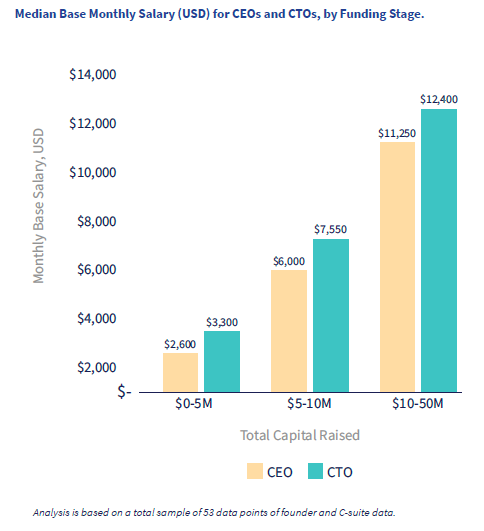
Across the region, the median compensation of CEO and CTO starts at $2,600 and $3,300 respectively, and increases as the startup raises more funding. Median CTO base salary was consistently higher than CEO salary, suggesting that CEOs are often willing to take a pay cut in favor of their technical counterparts, who are typically highly valued and considered scarce assets to the company.
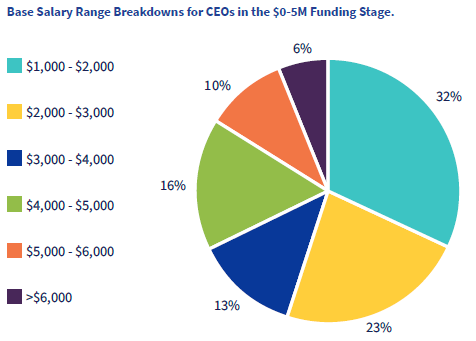
Looking at the compensation for CEOs running startups at the $0-5M funding stage, there is a large disparity in compensation ranging from $1,000 per month to $7,300 per month. This is partially a result of the different regions respondents were based in, the median stands at $2,600. Out of respondents within the 0-5M range, 32% pay themselves between $1,000 and $2,000 per month, while a further 23% pay themselves between $2,000 to $3,000 per month. In Vietnam, CEO salaries ranged from $1,000 per month at the $0-5M stage, to $6,000 at the $5-10M stage. In Indonesia, the median CEO salary at the $0-5M stage was $2,000. In Singapore, it was $4,000. At the $10-50M funding stage, the median CEO salary in Singapore was $11,500.
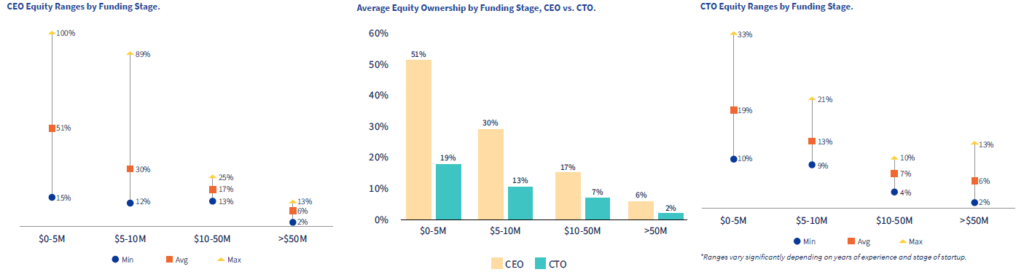
CEOs also tend to own more equity in the company compared to CTOs. The spread in equity ownership is highest for CEOs at the earliest stages of the company and gradually shrinks over time with increased funding. It is common for CEOs at the $0-5M stage to own between 15%-100% of the company’s equity. However, by the time the company reaches $50M in funding, CEOs have on average been diluted to 6% equity ownership.
In the case of CTOs, they typically own between 2-33% of the company depending on the capital raised (i.e. CEOs tend to own about 2-3x more equity compared to CTOs). At $5-10M, CTOs surveyed owned between 9% to 21% of the company. This is still considered sizable ownership in the company and indicates the importance of the role in a tech startup. The average ownership of CTOs is 19% in a $0-5M funding stage startup. We see declining trends in equity share for both positions as the company raises more funding, giving up shares to new investors who join the cap table in later rounds.
Compensation for Other Key Hires
Vice President / Head (Engineering)
According to founders, VP (Engineering) is one of the most critical hires. As a result, compensation data is highly sought after for this role. Singapore-based startups at Series B onwards paid a base monthly salary ranging from $7,500 - $10,000, with equity compensation ranging from 0.3% - 1.2%. In Indonesia, VP (Engineering) roles ranged from $2,800 - $7,100 depending on the stage of the company. In Vietnam, early-stage companies paid on average $1,000 - $5,000 for this role, $5,000 - $6,000 for post Series A, and $8,000 - $10,000 for Series B and above.
Vice President / Head (Product)
VP (Product) roles for mid-stage tech startups in Singapore ranged from $9,000 to $12,000, with a median equity compensation of 0.3%. At late-stage and big tech companies, VP (Product) roles in Singapore ranged from $15,000 - $19,000.
Other Tech Hires (Discussed by Departments)
Engineering
Engineering was ranked as the most in-demand role across Singapore, Indonesia, and Vietnam. Engineering salaries are also among the highest when it comes to tech startup roles.
Full-stack developers have the widest pay range due to the multiple skill sets they possess. It is hard to come by talent with competencies in frontend and backend development in the market. Most developers would have gained expertise in either frontend or backend and complemented their tech stack through exposure to managing horizontal projects.
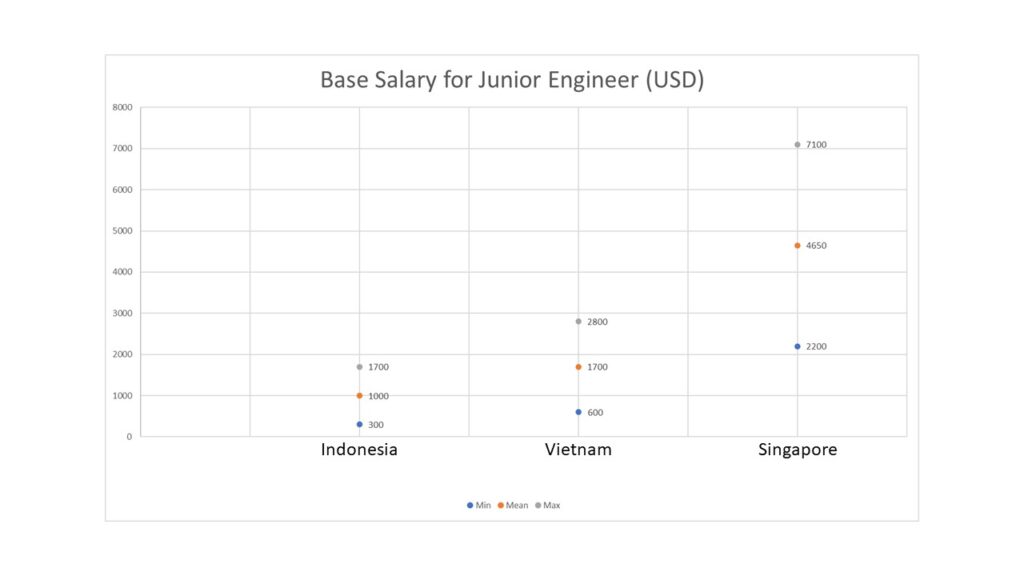
The range for junior developer salaries also varies widely. Due to an oversupply of fresh graduate junior engineers in markets such as Indonesia and Vietnam, starting salaries can be low. However, they quickly grow with a few years of experience. For example, while starting salaries for the most junior engineers can be low in Vietnam, they quickly grow to the range of $700 - $1,200 with 1-2 years of experience.
Engineering roles in Vietnam pay significantly more than in Indonesia. Median salaries for junior frontend, backend, and full-stack engineers are 2.5x higher in Vietnam than in Indonesia. Singapore engineers are paid the highest across all markets. The variation in salary ranges and skill levels across the region points to the benefits of adopting a regionally distributed and diversified approach to hiring and leveraging technical talent.
In big tech companies and late stage startups, it is pretty common to see the following ranges of base salaries for engineering roles:
- Full Stack Engineer / Senior Full Stack Engineer: $4,900 to $10,200
- Backend Software Engineer: $5,300 to $7,100
- DevOps Engineer / Senior DevOps Engineer: $5,300 to $9,400
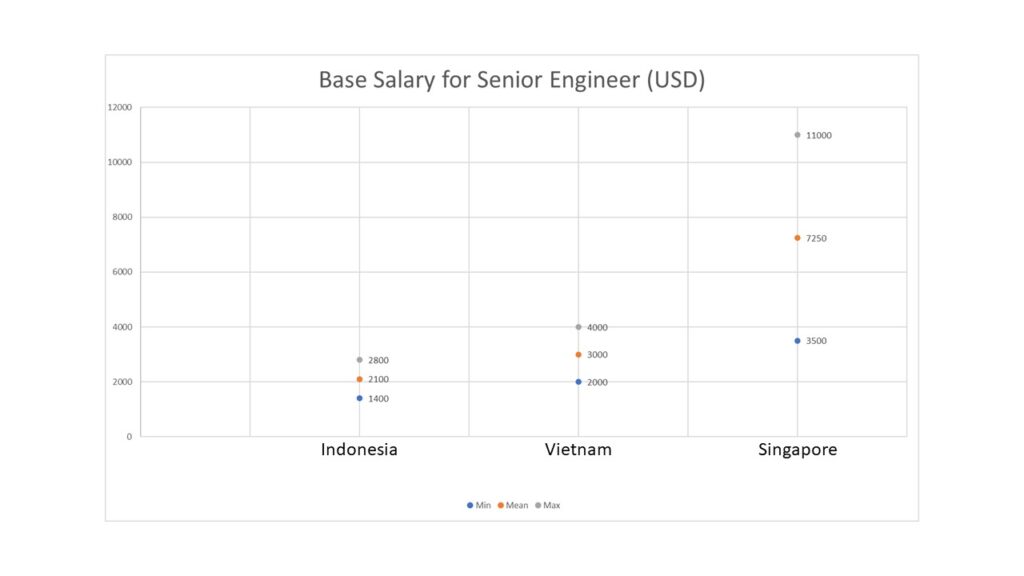
Please refer to the report for a detailed salary breakdown of engineers.
Product Management
Similar to engineering talent, product tech talent is one of the most sought-after in Southeast Asia. In Indonesia in particular, 20% of our survey respondents mentioned product as the most in-demand role. Controlling for market and seniority, product roles in Indonesia were paid double non-tech roles, and 23% more than engineering roles, reinforcing the scarcity of tech talent. Product manager positions with fewer technical skill requirements tend to earn less than those that deal with larger engineering complexities.
From the Founder Interviews, a big focus of attracting and retaining such talent is on one-on-one time, selling the vision, the growth trajectory of the company and its products, tech and product innovation, and strong leadership.
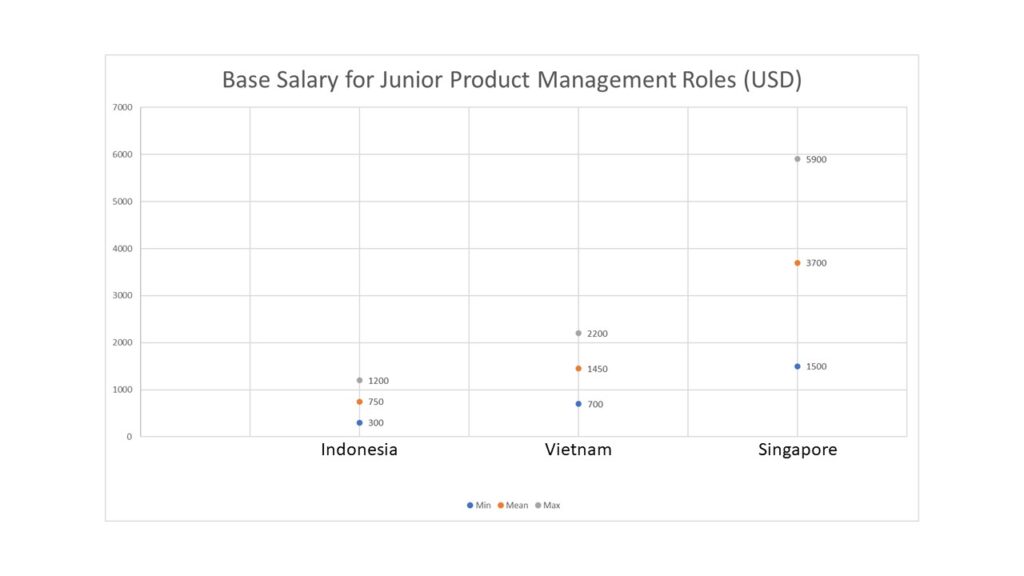
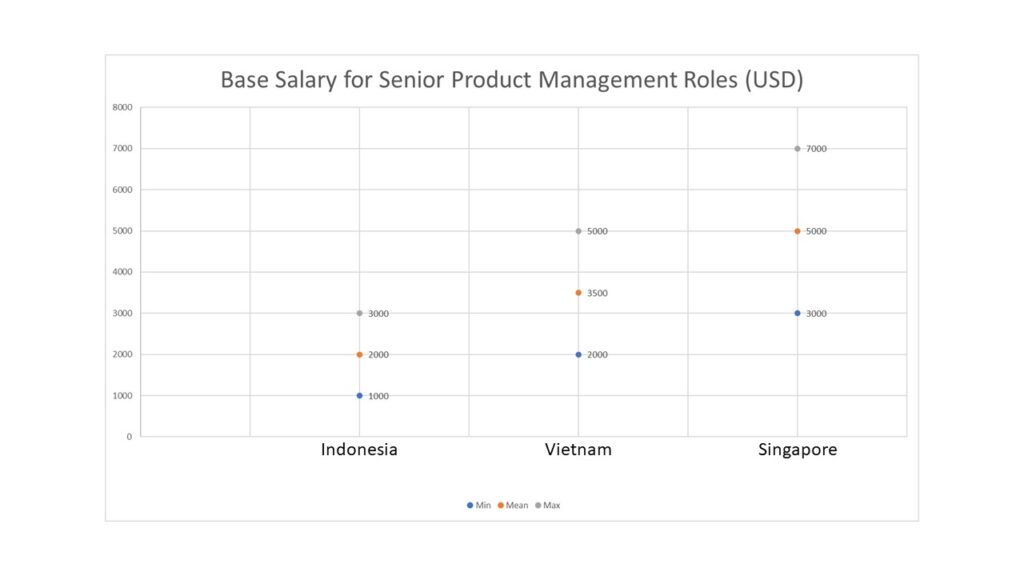
Please refer to the report for a detailed salary breakdown of Product Managers & UI/UX Designers.
Data Science
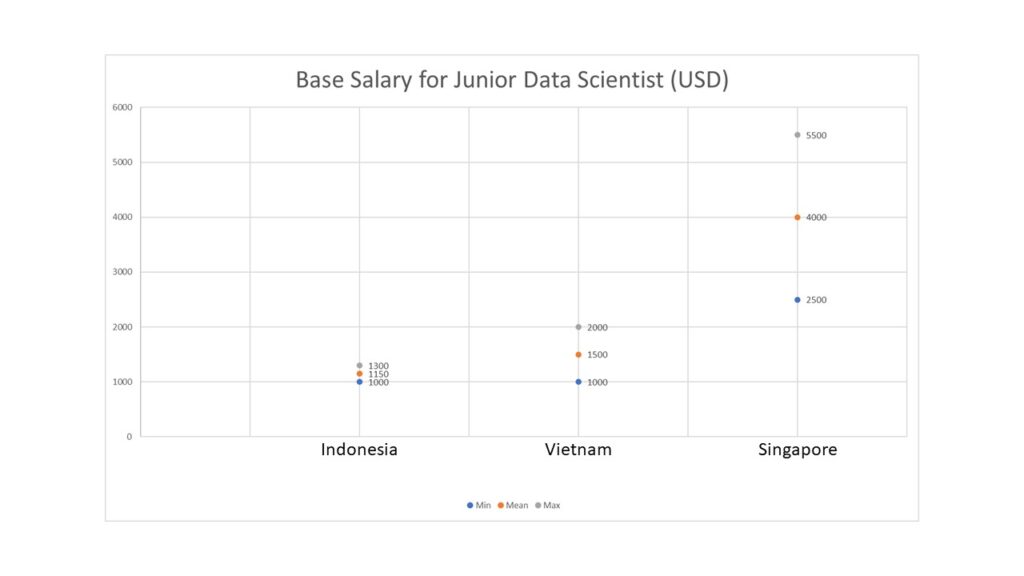
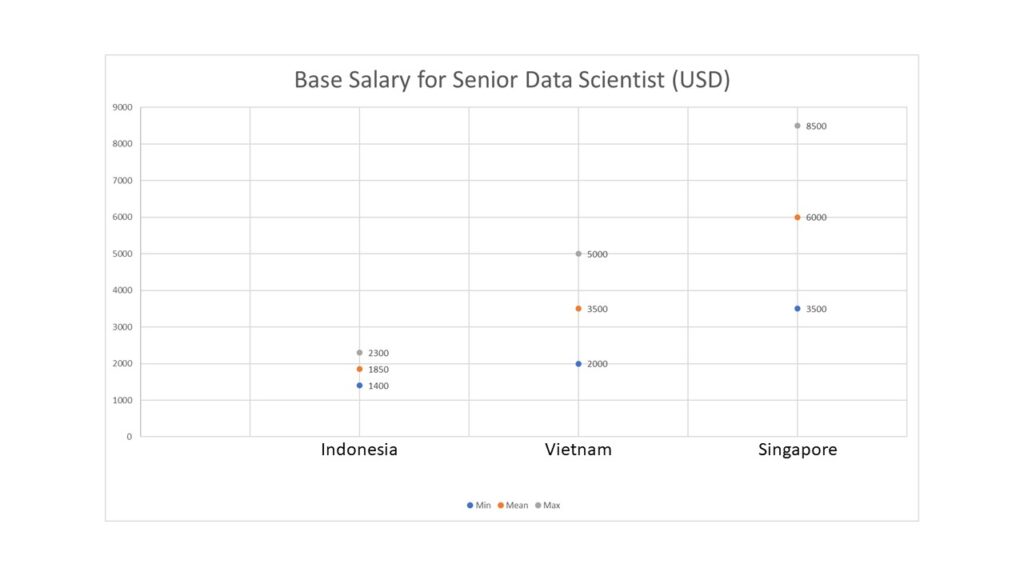
With the proliferation of big data, artificial intelligence, the internet of things, data analytics, etc., there is a boom in demand for data scientist roles in startups. Throughout the region, data science roles - including data analyst, data scientist, and data engineering - continue to be critical for startups in understanding their customers, devising their business strategies, and driving scale. It was discovered that data science is the third most in-demand role after engineering and product across Singapore, Indonesia, and Vietnam.
Non-Tech Roles: Marketing & PR
Scaling is key for any startup to raise future rounds of funding, and with scaling, comes marketing and PR. Marketing & PR can be classified into four different categories: Growth, Product, Brand and PR Communications.
In Singapore, the base salary for the different marketing functions is similar at $3,000 to $5,600 for junior positions. At junior levels, growth marketers receive the highest compensation due to the technical competencies required. However, in senior roles, product marketing and PR lead the pack.
- Brand Marketing
- Junior: $3,000 - $4,000
- Mid: $4,000 - $6,000
- Senior: $6,000 - $8,000
- Product Marketing
- Junior: $3,000 - $5,500
- Mid: $5,500 - $9,000
- Senior: $9,000 - $12,000
- Growth Marketing
- Junior: $3,700 - $5,600
- Mid: $5,200 - $7,500
- Senior: $7,500 - $8,900
- Public Relations
- Junior: $2,200 - $3,400
- Mid: $3,200 - $4,500
- Senior: $4,500 - $11,000
Culture & Scaling Up
1) Founders should aim to structure, convey and set an example regarding the company's cultural values, vision and mission early.
We have codified our cultural values and mission into a simple one-page document to represent who we are as a team. I believe that this is particularly important to do this even though we only have 15 people on the team, because it is a lot harder to change the culture of the company as you grow.
Dorothea Koh, Co-Founder & CEO of Bot MD
It’s not necessarily about the culture of the company but the mission… People work for a purpose and not just for the salary
Roshini Mahtani, Founder & Group CEO of theAsianparent
2) Founders should aim to hire the right people from the start. This will not only help with the progress of the company, but with talent retention as well. The old saying of "Hire Slow and Fire Fast" still holds today.
We found that team members started to bring in like-minded people from a cultural values perspective, and this became a positive talent flywheel in itself … 50% of our performance evaluation is based on demonstration of cultural values
Oswald Yeo, Co-Founder & CEO of Glints
Retaining talent is simple. Build a high-performing environment where everyone genuinely enjoys coming to work, loves what they do, and can tie what they do on a daily basis back to the overall mission of the company.
Dorothea Koh, Co-Founder & CEO of Bot MD
3) While startups are usually unable to offer the best compensation package for talents, they can attract and retain them with growth & learning opportunities given their agility compared to tech giants.
For those who value non-salary factors, like being empowered to make a direct impact on the product, we offer cultural factors and it’s something many of our current teammates value about working at Carousell.
Marcus Tan, Co-Founder & President of Carousell
Our hiring philosophy is not just about attracting the best talent that money can buy, we also look at factors such as their longevity in our workplace environment... we still attract talented individuals to join us. I think there are still many engineers and ex-tech unicorn talents out there who would like to shape early-stage product development in a meaningful way. Often that means that they would be happy to look at other benefits of working with us, rather than make the decision based on compensation.
Paul Hadjy, Co-Founder & CEO of Horangi
We tend to focus more on growth and learning to retain graduate talent.
Lai Chang Wen, Co-Founder & CEO of Ninja Van
A big part of our strategy is to go where others haven’t gone, but where there is great talent… We try to compete based on the learning and experience the talent stands from joining us
Oswald Yeo, Co-Founder & CEO of Glints
Conclusion
In summary, there is a high demand for talent with technical expertise, especially those with specialized skill sets such as machine learning and data science. However, the region lacks the supply of such talents. This results in the high demand for tech talent in both startups and big tech companies, technical roles generally have a higher monthly compensation as compared to non-technical roles even at the C-suite level.
As far as talent competition for startups against big-tech companies goes, it is crucial that startups stay nimble and attract talents using their company’s mission, vision, values, and growth opportunities to attract like-minded highly capable talents.
Please refer to the full report here for the comprehensive findings.